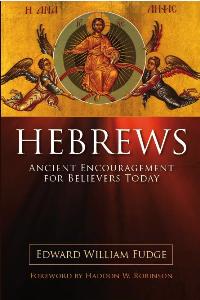
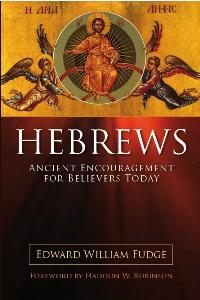
 HEBREWS: ANCIENT ENCOURAGEMENT FOR BELIEVERS TODAY, by Edward William Fudge (Leafwood Publishers, 2009, softcover, 262 pages, $19.95. Delivery on or before May 19, 2009 ).
The following is an interview with Edward William Fudge, author of HEBREWS: ANCIENT ENCOURAGEMENT FOR BELIEVERS TODAY (Leafwood Publishers, 2009, softcover, 262 pages, $19.95). Delivery on or before May 19, 2009).
A neglected book
Q: Hebrews is not a book we hear discussed very often. Why do you suppose that is the case?
EWF: You are right about that. This neglect is very unfortunate, in my view, because Hebrews is one of the most Jesus-focused, gospel-packed books in the New Testament. You will see the evidence for that on almost every page of Hebrews: Ancient Encouragement for Believers Today.
Q: Why do most people miss this focus?
EWF: It comes from a lack of real study of Hebrews. Folks go away from it without ever seeing and appreciating the book’s real message. They assume it is just an old book about even older Jewish rituals, sacrifices and priests, with no meaning or value for them.
Who wrote Hebrews?
Q: Do you know who wrote Hebrews?
EWF: I know as much about it as anyone else, which is finally nothing for sure! J Origen told the truth about two centuries after Christ when he said that the author “is known to God alone.” It almost certainly was not Paul, for a variety of reasons. My personal vote among the candidates goes either to Barnabas or to Apollos.
Q: Why do you favor Barnabas?
EWF: The author of Hebrews calls his own work a “word of exhortation” (Heb. 13:22). The same Greek expression is found at Acts 13:15, where it is translated as “word of encouragement.” There, Paul and Barnabas are invited to address a Sabbath synagogue audience, which they do for the next 31 verses. Their remarks are called a “word of encouragement.” Not only is Barnabas involved in that, his name means “son of encouragement” (Acts 4:36) – a comment on one of his chief characteristics. He is also a Levite, who would be very interested in the subjects of priesthoods, sacrifices, and their results. These themes permeate Hebrews and can also encourage us today, as I show in Hebrews: Ancient Encouragement for Believers Today.
Q: What can you say in favor of Apollos?
EWF: Well, for starters he is called “mighty in the Scriptures” (Acts 18:24). This fits Hebrews very well since its author clearly was exceedingly familiar with his ‘Bible,’ which was the “Old Testament” as we call it. (Hebrews actually tells the Story of the Son of God — from heaven to earth and back to heaven again — based on four different Psalms.) Apollos was also “an eloquent man,” as was the author of Hebrews). And he was from Alexandria, Egypt – a city of learning noted for a particular type of Scripture interpretation. The author of Hebrews reads his Bible in a similar manner.
Why was Hebrews written?
Q: Do we know why Hebrews was written?
EWF: Yes we do, although we don’t know exactly to whom, when, where, or precisely what was going on. But we do know that, for a variety of reasons, the original recipients of Hebrews were worn out, disheartened, tempted, and seemingly about ready to walk away from their faith. The book hints at some possible causes, including persecution, passing of time, being misfits in their culture, the appeal of sin, and so forth.
Q: That situation sounds very up-to-date! How does the author of Hebrews respond to it?
EWF: I love it! To revive his readers’ spirits and to renew their commitment, the unknown author re-tells the Story – the story of the Son of God who became a man, to live and die as our representative, and who is now in heaven representing us as our High Priest. Hebrews is thoroughly focused on Jesus! Its message is always contemporary. We can never go wrong by focusing on the Savior himself. I am very pleased that several reviewers have described Hebrews: Ancient Encouragement for Believers Today in those same terms.
A ‘bridge’ commentary
Q: You call Hebrews: Ancient Encouragement for Believers Today a “bridge” commentary. What does that mean?
EWF: When it comes to Bible studies, there are two worlds out there which often never come together. One is the ivory-tower world of academic specialists with all their scholarly issues and technical jargon. The other world is where most believers live and work and worship. Hebrews: Ancient Encouragement for Believers Today attempts to bridge this gap. For example, I worked from the Greek text of Hebrews but Hebrews: Ancient Encouragement for Believers Today doesn’t have a single Greek word in it. Although the bibliography covers eight pages and includes 80+ scholarly articles from theological journals, this book uses everyday language. By linking scholarship with simplicity, I hope to give the reader the best of both worlds.
A narrative-style book
Q: You also describe Hebrews: Ancient Encouragement for Believers Today as a “narrative-style” commentary. Tell us about that.
EWF: That refers to the fact that Hebrews: Ancient Encouragement for Believers Today is written as flowing narrative, although it discusses each verse of Hebrews in detail. It does this in 48 chapters, each covering a portion of the Scripture text. Each chapter begins with a very short section called “Why & Wherefore,” which relates that section to the big picture. That is followed by “Unpacking the Text,” which goes into detail, but in narrative style, with subheads to make it read more like a typical book.
Endorsements
Q: I see that Hebrews: Ancient Encouragement for Believers Today is already endorsed by a considerable variety of notable scholars and church leaders, even before its release. Isn’t that a bit unusual?
EWF: What is somewhat uncommon in the case of Hebrews: Ancient Encouragement for Believers Today is the theological and international diversity of the endorsements. Hebrews contains a number of quite controversial passages, about which Christian “tribes” traditionally disagree. I am very pleased, therefore, that this book is recommended by knowledgeable reviewers across the spectrum.
For example, the quotes on the back cover of Hebrews: Ancient Encouragement for Believers Today come from Methodist, Calvinist, Church of Christ, Baptist, mainline Protestant, Pentecostal and Emergent church scholars. The full text of these seven endorsements, plus 29 others, fills the first six pages of the book. You can read the endorsements online already, with photos, biographical comments and (where applicable) website links of the reviewers, by clicking here http://www.EdwardFudge.com/endorsements_Heb.html .
Tomorrow I plan to post my review of this important book.
Royce
 In church of Christ circles Edward Fudge is both despised and loved but one thing everyone, including those outside of churches of Christ, can agree on is Edward’s consistant, life long habit of putting the focus of his message and ministry on Jesus Christ our Lord.
 Grace Digest