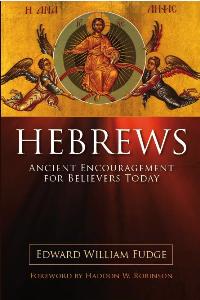
Edward Fudges talks about his latest book


coverpichebHEBREWS:  ANCIENT  ENCOURAGEMENT FOR  BELIEVERS TODAY, by Edward William Fudge (Leafwood Publishers, 2009, softcover, 262 pages, $19.95. Delivery on or before May 19, 2009 ). 

The following is an interview with Edward William Fudge, author of HEBREWS: ANCIENT  ENCOURAGEMENT FOR  BELIEVERS TODAY (Leafwood Publishers, 2009, softcover, 262 pages, $19.95). Delivery on or before May 19, 2009).  

A neglected book 

Q: Hebrews is not a book we hear discussed very often. Why do you suppose that is the case? 

EWF: You are right about that. This neglect is very unfortunate, in my view, because Hebrews is one of the most Jesus-focused, gospel-packed books in the New Testament. You will see the evidence for that on almost every page of Hebrews: Ancient Encouragement for Believers Today. 

Q: Why do most people miss this focus? 

EWF: It comes from a lack of real study of Hebrews. Folks go away from it without ever seeing and appreciating the book’s real message. They assume it is just an old book about even older Jewish rituals, sacrifices and priests, with no meaning or value for them.   

Who wrote Hebrews? 

Q: Do you know who wrote Hebrews? 

EWF: I know as much about it as anyone else, which is finally nothing for sure! J Origen told the truth about two centuries after Christ when he said that the author “is known to God alone.” It almost certainly was not Paul, for a variety of reasons. My personal vote among the candidates goes either to Barnabas or to Apollos. 

Q: Why do you favor Barnabas? 

EWF: The author of Hebrews calls his own work a “word of exhortation” (Heb. 13:22). The same Greek expression is found at Acts 13:15, where it is translated as “word of encouragement.” There, Paul and Barnabas are invited to address a Sabbath synagogue audience, which they do for the next 31 verses. Their remarks are called a “word of encouragement.” Not only is Barnabas involved in that, his name means “son of encouragement” (Acts 4:36) – a comment on one of his chief characteristics. He is also a Levite, who would be very interested in the subjects of priesthoods, sacrifices, and their results. These themes  permeate Hebrews and can also encourage us today, as I show in Hebrews: Ancient Encouragement for Believers Today. 

Q: What can you say in favor of Apollos? 

EWF: Well, for starters he is called “mighty in the Scriptures” (Acts 18:24). This fits Hebrews very well since its author clearly was exceedingly familiar with his ‘Bible,’ which was the “Old Testament” as we call it. (Hebrews actually tells the Story of the Son of God — from heaven to earth and back to heaven again — based on four different Psalms.) Apollos was also “an eloquent man,” as was the author of Hebrews). And he was from Alexandria, Egypt – a city of learning noted for a particular type of Scripture interpretation. The author of Hebrews reads his Bible in a similar manner. 
 

Why was Hebrews written?

Q: Do we know why Hebrews was written? 

EWF: Yes we do, although we don’t know exactly to whom, when, where, or precisely what was going on. But we do know that, for a variety of reasons, the original recipients of Hebrews were worn out, disheartened, tempted, and seemingly about ready to walk away from their faith. The book hints at some possible causes, including persecution, passing of time, being misfits in their culture, the appeal of sin, and so forth. 

Q: That situation sounds very up-to-date! How does the author of Hebrews respond to it? 

EWF: I love it! To revive his readers’ spirits and to renew their commitment, the unknown author re-tells the Story – the story of the Son of God who became a man, to live and die as our representative, and who is now in heaven representing us as our High Priest. Hebrews is thoroughly focused on Jesus! Its message is always contemporary. We can never go wrong by focusing on the Savior himself. I am very pleased that several reviewers have described Hebrews: Ancient Encouragement for Believers Today in those same terms.  

A ‘bridge’ commentary 

Q: You call Hebrews: Ancient Encouragement for Believers Today a “bridge” commentary. What does that mean?  

EWF:  When it comes to Bible studies, there are two worlds out there which often never come together. One is the ivory-tower world of academic specialists with all their scholarly issues and technical jargon. The other world is where most believers live and work and worship. Hebrews: Ancient Encouragement for Believers Today attempts to bridge this gap. For example, I worked from the Greek text of Hebrews but Hebrews: Ancient Encouragement for Believers Today doesn’t have a single Greek word in it. Although the bibliography covers eight pages and includes 80+ scholarly articles from theological journals, this book uses everyday language. By linking scholarship with simplicity, I hope to give the reader the best of both worlds.  

A narrative-style book 

Q: You also describe Hebrews: Ancient Encouragement for Believers Today as a “narrative-style” commentary. Tell us about that. 

EWF: That refers to the fact that Hebrews: Ancient Encouragement for Believers Today is written as flowing narrative, although it discusses each verse of Hebrews in detail. It does this in 48 chapters, each covering a portion of the Scripture text. Each chapter begins with a very short section called “Why & Wherefore,” which relates that section to the big picture. That is followed by “Unpacking the Text,” which goes into detail, but in narrative style, with subheads to make it read more like a typical book. 

Endorsements 

Q: I see that Hebrews: Ancient Encouragement for Believers Today is already endorsed by a considerable variety of notable scholars and church leaders, even before its release. Isn’t that a bit unusual? 

EWF: What is somewhat uncommon in the case of Hebrews: Ancient Encouragement for Believers Today is the theological and international diversity of the endorsements. Hebrews contains a number of quite controversial passages, about which Christian “tribes” traditionally disagree. I am very pleased, therefore, that this book is recommended by knowledgeable reviewers across the spectrum. 

For example, the quotes on the back cover of Hebrews: Ancient Encouragement for Believers Today come from Methodist, Calvinist, Church of Christ, Baptist, mainline Protestant, Pentecostal and Emergent church scholars. The full text of these seven endorsements, plus 29 others, fills the first six pages of the book. You can read the endorsements online already, with photos, biographical comments and (where applicable) website links of the reviewers, by clicking here http://www.EdwardFudge.com/endorsements_Heb.html

Tomorrow I plan to post my review of this important book.

Royce


Smoke on the Mountain


Tonight it was my joy to go with my daughter and a friend to the Strauss Theater here in Monroe to see the musical “Smoke on the Mountain”. What fun! We laughed a lot, we sang a lot, and we were reminded of times gone by and our wonderful Lord.

The setting for the play is the Mount Pleasant Baptist Church in Mount Pleasant, North Carolina just west of Hickory near the Blue Ridge Mountains in 1939. The 63 member church is hosting a Saturday night singing and the guests are the singing Sanders family from Slier City up on Highway 11.

The actors sang hymns, gospel songs, blue grass gospel tunes, and gave testimony to what Jesus had done for them and lamented hard times and the closing of the pickle factory in Mount Pleasant. It was a wonderful, very entertaining evening. I saw John and Maggie Dobbs and the Riley’s, Chuck Adams who leads my 6:30 a.m. men’s group on Wednesdays, and other friends.

As I enjoyed the show the memories flooded my mind. The Singing Sanders family owned a filling station and they talked about Esso gasoline and selling Ne-Hi colas. And of course the church set was very familiar.

In my late teens and through my twenties I attended many Saturday night signings at little frame churches stuck on the side of a hill up in a hollow in the Blue Ridge. The singers were often family members. I was always amused that at least one of the groups would begin their part of the program by one of them saying something like “We an’t much at singing but we like to make a joyful noise for the Lord“. Well, let me tell you, that disclaimer was usually a prophecy! At least 25%  of them couldn’t sing a lick but they tried, and most of them earnestly believed it was one way they could serve the Lord.

Many, many times I led singing at some little church on the side of road where someone I knew was holdin’ a revival and didn’t have a song leader. I was a pitiful excuse for a song leader but I was glad to try. My wife and I would often sing a couple of songs a cappella like More about Jesus…

More about Jesus I would know, more of His grace to others show.
More of saving fullness see, more of His love who died for me.

More, more about Jesus,
More, more about Jesus;
More of His saving fullness see,
More of His love Who died for me.

A good crowd at those little country churches would be 30 or 40. They were country people who for the most part lived off the land, hard working folks who lived a hard life by today’s standards but they loved God and  were doing what they could for the kingdom.

I have preached to perhaps 15 or 18 and I have preached to several hundred and I had just as much joy sharing my heart with those wonderful, simple people, my people, as when I spoke to 800 or so upper middle class people in the city.

I have seen first hand the power of the gospel of Christ. I’ve seen drunks dried up, men addicted to cheap drugs for years delivered in an instant never to use them again. I have seen rough mountain men like my own father changed from bitterness and hopelessness into humble servants of Christ. I don’t know how to explain it but in those days we were not bothered much by hypocrites. Most of those mountain folks were pretty easy to figure. What you saw was what you got. Most of the time a man was exactly what he claimed he was. Yes, there was few devils about but they were the rare exception. Even our drunkards believed the virgin birth of Jesus and that the Bible was the word of God. Everybody respected the preacher. He was the one who would help them get to heaven, bury their dead, and marry their children. He was without question, God’s man.

I am fortunate to have the heritage that I enjoy and appreciate. I am familiar with folks  who believed the only reason to pray was to get what you asked for. Their word was their bond and nobody locked their doors or took the keys out of their cars. It was  good place to grow up and a good place to meet God and begin what is now my almost 50 years of walking with him.

If you ever have a chance to see “Smoke on the Mountain” I recommend it. You’ll get just a glimpse into my history and get to know my people from the hills.

Grace be with you,
Royce


The Dumbing Down of Discipleship, Superficial Scholarship in the churches of Christ


In the last several months there have been several dozen blog posts and articles in coC journals about the decline both of the number of churches and membership. The Christian Chronicle has done a good job of examining the raw data available and raising some relevant questions as to why this trend is real.

I have read letters to the editor, blog posts, and listened to on line sermons, each with some suggestion about how to stop the downward spiral. Most of what I have read only touches upon symptoms and does not address the heart of the problem.

Last night I listened to a message preached by John McCord to his people at the El Campo church of Christ in El Campo, Texas. I invite you to listen to this young man’s sermon. John McCord is one example of a preacher who has decided to no longer facilitate the falsehood of legalistic teaching. This is an example of someone with the courage to bring ethics into the pulpit along with his Bible.

All of the hand wringing and ideas about how to be more relevant, develop better programs, and become more attractive to our communities are all exercises in futility unless the root of the problem is addressed. Shoddy and sometimes even dishonest Bible scholarship is our greatest problem.

The recent uproar about 21st Century Christian not including congregations in their directory that had one or more instrumental service on Sunday highlighted a shocking truth. Today, almost 25% of the members of churches of Christ in the United States attend a congregation which has at least one service on Sunday where singing is accompanied by musical instruments.(I am sure there are others the keepers of the gate to heaven have not discovered yet) This is not the problem. The awful truth is that many of the remaining 75% don’t believe the 25% is going to heaven because they have the dreaded “instrument”. This undeniable fact gets at the root of the decline of the numbers of congregations and members. Many educated, thinking people simply dismiss this sort of nonsense as silly and either move on to some other church of Christ or quietly leave the church tradition of their ancestors.

Why should we expect people to be drawn to or stay in a church that teaches you are in danger of hell fire if you don’t agree with what they teach, and what they teach can’t be supported by the Bible? Almost every member of our churches has a computer at home and within a few clicks of a mouse they can tap into the wisdom of trusted theologians on any given subject and quickly decide if a teaching is Biblical or a myth.

We must devote ourselves to honest interpretation of the scriptures and lay aside the traditions of men if they are not valid. Each of us will do so at great risk but it is worth the effort. Christian discipleship is not for the thin skinned and faint of heart. If you set out to be loyal only to Christ and the word of God you will become the target of zealots whose security is not in Christ but rather in what they do, the system they have endorsed, and the religion they are committed to.

To be what God wants us to be, without regard to the numbers or our critics, we must get back to the basics of the Christian faith. We must become a people of the Word whose lives have the flavor of an authentic, vibrant faith relationship with Jesus Christ. Every area of our lives should reflect our devotion to the Son of God and our unconditional surrender to His will. We must become known as people who love each other unconditionally, who hold each other accountable, who look out for the interests of others, and whose mission on earth is to make Christ known.

True disciples of Jesus are known by how they love. They are not known by how they worship, by what sign is over the door where they worship, or by what their church history is.They are known by loving each other and by loving even their enemies and by so doing loving God.

We must stop pretending we have it all right and everyone else is wrong. We must stop being church centered and become Christ centered. It is high time the Restoration Movement churches are restored to the faith of our fathers without all the trappings of man made religion. It is a life or death matter.

Royce

What is Repentance?


“Repent!” was the common message of John the Baptist, of Jesus, and of Peter. Peter having been baptized with the Holy Spirit preached the good news about Jesus to his murderers and the others and they were deeply convicted and convinced of their need of Christ and His forgiveness and cried out “What must we do?” (Acts 2:38) Peter’s answer was “Repent and be baptized every one of you in the name of Jesus Christ for the forgiveness of your sins, and you will receive the gift of the Holy Spirit”.


I think it is odd then that some people teach that a sinner must “clean his life up” (repent) before he can become a Christian. And, because of this teaching I have given the good news about Jesus to men who have responded, “I am not good enough yet”, or “I am not ready yet, I need to change some things in my life”. Asking a sinner to change his life is like asking a corpse to wave at you, it is impossible.


Repentance is not unlike faith as I discussed in my last post. Repentance is not subjective, but like faith it is objective. Faith’s object is Christ. Acts 2:21 says it well, “testifying both to Jews and to Greeks of repentance toward God and of faith in our Lord Jesus Christ”. I made the case that biblical, saving faith, begins at a moment in time and is proved up by corresponding works. In the same way repentance occurs at a moment in time and is proved up by a lifestyle change. Consider these verses that clearly make this clear. Stopping bad behavior and beginning good behavior is not repentance but rather the evidence you have repented.


Bear fruit in keeping with repentance(Matthew 3:8) 

But declared first to those in Damascus, then in Jerusalem and throughout all the region of Judea, and also to the Gentiles, that they should repent and turn to God, performing deeds in keeping with their repentance.” (Acts 26:20) 

Just as with faith, good works show that you have faith, they are not the cause of it, so too good deeds show you have repented, they are not repentance. The person who has truly repented will live differently. His lifestyle will show he has repented.


To those who are depending on their own works of righteousness the Hebrew writer said “Therefore let us leave the elementary doctrine of Christ and go on to maturity, not laying again a foundation of repentance from dead works and of faith toward God.” (Hebrews 6:1) Here it is clear that repentance and faith are foundational, they are the starting point of becoming a Christian. It should be noted that one of the things a penitent sinner should change is to stop depending on dead works (self righteousness).


Repentance, like faith, is given by God. The ability to truly repent is given by God.


“God exalted him at his right hand as Leader and Savior, to give repentance to Israel and forgiveness of sins.” (Acts 5:31) 

“When they heard these things they fell silent. And they glorified God, saying, “Then to the Gentiles also God has granted repentance that leads to life” (Acts 11:18) 

“…Correcting his opponents with gentleness. God may perhaps grant them repentance leading to a knowledge of the truth”.(2 Timothy 2:25) 

Only when the Holy Spirit has done His blessed work will a sinner trust Christ and change his mind about the direction of his life. Repentance and faith are so closely joined together that they can’t be understood well apart from each other. No person can fully trust Christ without a change of mind about how he is living. And, no person can fully repent who does not place his trust in Christ.


Repentance is no more than a divinely enabled choice to do a mental U-turn. Repentance is to change one’s mind and thus the direction of one’s lifestyle. It is impossible to turn to Christ and not turn away from sin. And it is impossible to turn from sin without turning toward Christ.


How can you tell if a person has repented? This is the way the Bible describes it. Jesus spoke to Paul saying in part “I am sending you to open their eyes, so that they may turn from darkness to light and from the power of Satan to God, that they may receive forgiveness of sins and a place among those who are sanctified by faith in me.”
(Acts 26:17, 18) The same truth is stated again “For they themselves report concerning us the kind of reception we had among you, and how you turned to God from idols to serve the living and true God.” (1Thessalonians 1:9) People who have truly repented will not only have a change of mind but a change of life.


The message has not changed. “The times of ignorance God overlooked, but now he commands all people everywhere to repent, because he has fixed a day on which he will judge the world in righteousness by a man whom he has appointed; and of this he has given assurance to all by raising him from the dead.” (Acts 17:30, 31)


Jesus Christ will be the measure God uses to judge sinful men. You will both be justified, and finally saved at the resurrection because you have repented and turned to Christ, or you will be lost. Those who depend on their good deeds as a substitute or a supplement to what Christ has accomplished are living dangerously. “Not that we dare to classify or compare ourselves with some of those who are commending themselves. But when they measure themselves by one another and compare themselves with one another, they are without understanding. (2 Corinthians 10:12) If you judge yourself to be right with God because of what you do, I ask you, to whom are you comparing yourself? Only when you compare yourself to Jesus’ holy life will you see your need of him. Perhaps it is time to repent.


Royce