What is Repentance?


“Repent!” was the common message of John the Baptist, of Jesus, and of Peter. Peter having been baptized with the Holy Spirit preached the good news about Jesus to his murderers and the others and they were deeply convicted and convinced of their need of Christ and His forgiveness and cried out “What must we do?” (Acts 2:38) Peter’s answer was “Repent and be baptized every one of you in the name of Jesus Christ for the forgiveness of your sins, and you will receive the gift of the Holy Spirit”.


I think it is odd then that some people teach that a sinner must “clean his life up” (repent) before he can become a Christian. And, because of this teaching I have given the good news about Jesus to men who have responded, “I am not good enough yet”, or “I am not ready yet, I need to change some things in my life”. Asking a sinner to change his life is like asking a corpse to wave at you, it is impossible.


Repentance is not unlike faith as I discussed in my last post. Repentance is not subjective, but like faith it is objective. Faith’s object is Christ. Acts 2:21 says it well, “testifying both to Jews and to Greeks of repentance toward God and of faith in our Lord Jesus Christ”. I made the case that biblical, saving faith, begins at a moment in time and is proved up by corresponding works. In the same way repentance occurs at a moment in time and is proved up by a lifestyle change. Consider these verses that clearly make this clear. Stopping bad behavior and beginning good behavior is not repentance but rather the evidence you have repented.


Bear fruit in keeping with repentance(Matthew 3:8) 

But declared first to those in Damascus, then in Jerusalem and throughout all the region of Judea, and also to the Gentiles, that they should repent and turn to God, performing deeds in keeping with their repentance.” (Acts 26:20) 

Just as with faith, good works show that you have faith, they are not the cause of it, so too good deeds show you have repented, they are not repentance. The person who has truly repented will live differently. His lifestyle will show he has repented.


To those who are depending on their own works of righteousness the Hebrew writer said “Therefore let us leave the elementary doctrine of Christ and go on to maturity, not laying again a foundation of repentance from dead works and of faith toward God.” (Hebrews 6:1) Here it is clear that repentance and faith are foundational, they are the starting point of becoming a Christian. It should be noted that one of the things a penitent sinner should change is to stop depending on dead works (self righteousness).


Repentance, like faith, is given by God. The ability to truly repent is given by God.


“God exalted him at his right hand as Leader and Savior, to give repentance to Israel and forgiveness of sins.” (Acts 5:31) 

“When they heard these things they fell silent. And they glorified God, saying, “Then to the Gentiles also God has granted repentance that leads to life” (Acts 11:18) 

“…Correcting his opponents with gentleness. God may perhaps grant them repentance leading to a knowledge of the truth”.(2 Timothy 2:25) 

Only when the Holy Spirit has done His blessed work will a sinner trust Christ and change his mind about the direction of his life. Repentance and faith are so closely joined together that they can’t be understood well apart from each other. No person can fully trust Christ without a change of mind about how he is living. And, no person can fully repent who does not place his trust in Christ.


Repentance is no more than a divinely enabled choice to do a mental U-turn. Repentance is to change one’s mind and thus the direction of one’s lifestyle. It is impossible to turn to Christ and not turn away from sin. And it is impossible to turn from sin without turning toward Christ.


How can you tell if a person has repented? This is the way the Bible describes it. Jesus spoke to Paul saying in part “I am sending you to open their eyes, so that they may turn from darkness to light and from the power of Satan to God, that they may receive forgiveness of sins and a place among those who are sanctified by faith in me.”
(Acts 26:17, 18) The same truth is stated again “For they themselves report concerning us the kind of reception we had among you, and how you turned to God from idols to serve the living and true God.” (1Thessalonians 1:9) People who have truly repented will not only have a change of mind but a change of life.


The message has not changed. “The times of ignorance God overlooked, but now he commands all people everywhere to repent, because he has fixed a day on which he will judge the world in righteousness by a man whom he has appointed; and of this he has given assurance to all by raising him from the dead.” (Acts 17:30, 31)


Jesus Christ will be the measure God uses to judge sinful men. You will both be justified, and finally saved at the resurrection because you have repented and turned to Christ, or you will be lost. Those who depend on their good deeds as a substitute or a supplement to what Christ has accomplished are living dangerously. “Not that we dare to classify or compare ourselves with some of those who are commending themselves. But when they measure themselves by one another and compare themselves with one another, they are without understanding. (2 Corinthians 10:12) If you judge yourself to be right with God because of what you do, I ask you, to whom are you comparing yourself? Only when you compare yourself to Jesus’ holy life will you see your need of him. Perhaps it is time to repent.


Royce
What is Saving Faith?


The Bible teaches that sinners are saved by faith alone in Christ alone.

The moment I make this statement an array of emotions are invoked and people will line up to make the case that what I said is not true.  The reasons people think this statement is untrue can be narrowed down to two major lines of reasoning.

The first is the difficulty of people to grasp the scope of God’s love and ensuing grace. The idea that God would declare a wicked sinner not guilty, and then righteous, and give him eternal life and an inheritance in heaven just because he believed what God said in the gospel of Christ goes against every instinct of man. Such an idea is a scandal! Only the most naive would embrace such an idea! Surely sinful man must prove something to God before He can be approved.

I suggest the second, and larger problem is the common misunderstanding of what is meant by “faith“, especially “saving faith” in the Bible. A surprising number of people evidently believe that “believe” and “faith” are exactly the same in regard to salvation and have the most elementary meaning of each word in mind. It is common in our fellowship for a candidate for baptism to be asked “Do you believe Jesus Christ is the Son of God?”  The problem is that believing that truth is not faith. Giving mental assent to some facts is not what the Bible means when it talks about “belief” or “faith“.

There are many places in the Bible that perfectly illustrates what genuine saving faith is. One of my favorites is found in Hebrews 6.

“And without faith it is impossible to please him, for whoever would draw near to God must believe that he exists and that he rewards those who seek him.”
(Hebrews 11:6)

Without faith it is impossible to please Him…”. Since this is true we need desperately to know what “faith” is. The remainder of the verse explains it clearly.

I suggest that biblical, saving faith has three components, and lacking any one makes what one believes less than what God demands. The second section of the verse says, “for whoever would draw near to God…

  • must believe that he exists”. Unfortunately this is as far as many people ever get. They believe a set of facts about God and about Jesus in much the same way we believe stories about George Washington and Abraham Lincoln. Believing that Jesus was actually a historical figure, and that he was called “The Son of God” is good but is only part of  what faith is. I can give mental assent to historical facts but I never have to depend upon those facts, or put my trust in one of those historical figures. When Jesus told Nicodemus he should believe on Him he meant to “rely on”, to “lean on”, or to “dependently trust” in Him. This is the most fundamental or basic component of faith, it is intellectual.
  • “and that he rewards” It is not enough to believe God exists, we must also believe he will act on our behalf. This is the emotional aspect of faith. This is the point where what you believe in your head starts to be embraced by your heart. Paul’s description in Romans 10 clearly shows this, v9 “believe with your heart” and v10 “For with the heart one believes and is justified“. When I say I believe something with all my heart it is more meaningful than just a fact I have accepted as true.
  • “those who seek him” This is when faith is complete. Those who are seeking are acting. Until what you know if your head is true and what you embrace in your heart is acted upon it is not saving faith. This is the aspect of faith I have called volitional. It requires an act of the will to do something. Looking once more at the familiar passage in Romans 10 you read in v9 “if you confess with your mouth” and in v10 “with the mouth one confesses and is saved“. A person hears about Jesus and believes he exists, they believe in their heart that he will do something for them, and they then tell someone. It is in this context Paul writes in v13”everyone who calls on the name of the Lord will be saved“.

So then saving faith is intellectual, emotional, and volitional. Now it is easy to see that there is absolutely no tension between what Jesus and Paul taught and what James taught; “Faith without works is dead, being alone” A belief that stops short of surrendered obedience is too short to be biblical, saving faith. There are observable responses to the gospel. Going public with your faith by telling others (confession), reenacting the death, burial, and resurrection of Jesus in baptism, and a lifestyle of obedience to what you know to be what God wants of you are all observable and to some degree measurable. But none of these observable acts are worth a plug nickel if first there has not been the first two components of faith. Many, many people are trusting what they do (which are good and noble things) and are not depending on Christ alone. It is the outworking of that solitary dependent trust in him that matters for time and eternity.

Again and again Abraham is put forth as our example of a faithful and faith filled man. He “believed God and it was counted to him as righteousness”. Before he was circumcised, before Issac was conceived, before he took a step toward the place to where God would lead him, God declared him to be righteous. Let us not make the mistake of assigning human limitations to God who is unlimited. Do you not think God knew you, knew exactly what would would do on any given day, how you would sin, when you would hear the good news and respond? It is his foreknowledge that gives him the divine prerogative to justify a sinner in an instant who is yet to do those observable things. Now you will have to show me, and those to whom James wrote would have to show him (James 2:18), but God knows the beginning from the end.

The scriptures are very clear. Those who do not have the walk to match the talk are not Christians. Read 1 John. You will find over and over distinctions, a lifestyle of loving living by those who belong to God and are in Christ. They did not become Christians by doing those things, they do those things because they are in Christ. Because they have trusted him they love as he loved. 1 John 5 makes crystal clear that the division is made between the saved and lost by who believes on Christ and those who do not.

Are we saved by faith alone in Christ alone? Yes we are. But to affirm that statement we must know what is meant by “faith”. I hope this might help someone to understand better. Faith and works are not separated, they are always together in saving faith.

His peace,
Royce

The “Unknown God” of 21st Century Evangelicals


I readily confess to a play on words borrowed from the Apostle Paul in Acts 17 verse 23. While Paul was in Athens he passed the Athenian temple dedicated to the “Unknown God”. When he made his famous address to the listeners at the Areopagus he mentioned seeing an alter with the inscription “To the unknown God”. He went on to tell them about the God they did not know. The Areopagus was a gathering place for almost continuous speeches on all sorts of topics. The Athenians, and likely many visitors to the great city of Athens, had an unquenchable thirst for anything new. (Things haven’t changed much have they?)

The God Evangelicals claim allegiance to in our day is just as unknown, in the sense he is hardly recognizable when compared to the God of the Bible. Many of us are quick to point out the obvious excesses and extremes of those who are blatantly peddling their wares on TV and radio in the name of God so they can sit in gold plated chairs, drive Rolls Royce’s and Bentley’s, and enjoy lavish lifestyles at the expense of the ignorant. Meanwhile the God we profess to know, while slightly more moral than the one of the “you write it and I’ll cash it for Jesus” crowd, is a dependent weakling compared to the God of Holy Scriptures.

The God of the vast majority of self proclaimed “Christians” is one who thinks humans are the center of the universe and his chief purpose of being God is to make them happy and prosperous. You know, the God Joel Osteen supposedly speaks for every Sunday on TV. You don’t hear much about God followers being thrown to the lions or being sawed into from Osteen and others like him. Even those who don’t approve of Joel Osteen because of his perceived weakness on “sound doctrine” still largely buy into his grand idea of a man centered world populated by people, each of whom can have a heavenly father who is no more than a supernatural concierge who is waiting to supply their next wish list.

Christians are often personally offended when some happening in life is inconvenient or diminishes their pleasure in living. At once, while blaming God, they cry out to Him, “Why me?” What today’s average Christian wants from God is at a minimum an upper middle class lifestyle with two weeks paid vacation, healthy and bright children, no sickness that a trip to Rite Aid can’t cure, and an even more lavish home someday in heaven. They don’t really like being told much about how they should live their lives and certainly don’t entertain any thought of personal sacrifice for God. Are you kidding? Have you not heard that God is a loving Father full of grace and gifts to make me happy? Do you not know that God created us so he could have some friends, and that the reason he does so much for us is so we will love him? He was lonely in his big old young universe and he made us so he would have someone to talk to and do things for. He just wants us to love him back. He wants us to go to church, not get drunk, stop cursing, be nice to people we like, and tell other people about how nice he is to us. The bottom line is we are to imitate Jesus but God knows we can’t really do that so that is why Jesus died for us so God wouldn’t be mad at us.

This God we imagine has many of the limitations of humans. He doesn’t know what we will do until we have done it. And, he has made it so that pleasing a pastor or an elder is more important than pleasing him. This God gets his feelings hurt easily and in a fit of anger might just cause us to get cancer if we don’t toe the line. He doesn’t really like it when we cheat on our income taxes, tell dirty jokes at the office, and have a habit of lying, but He really will not do anything about it because he is all about love and good things.

This sort of God is an “Unknown God” to the pages of the Bible. The God of the Bible is far different. The center of the universe is God who is self sufficient and needs nothing and His chief end is His own glory and praise. We humans were created and recreated to that end. Ephesians chapter one gives the rationale for the redemptive scheme of God in Christ bringing sinners to himself.

“Grace to you and peace from God our Father and the Lord Jesus Christ. Blessed be the God and Father of our Lord Jesus Christ, who has blessed us in Christ with every spiritual blessing in the heavenly places, even as he chose us in him before the foundation of the world, that we should be holy and blameless before him. In love he predestined us for adoption as sons through Jesus Christ, according to the purpose of his will, to the praise of his glorious grace, with which he has blessed us in the Beloved. In him we have redemption through his blood, the forgiveness of our trespasses, according to the riches of his grace, which he lavished upon us, in all wisdom and insight making known to us the mystery of his will, according to his purpose, which he set forth in Christ as a plan for the fullness of time, to unite all things in him, things in heaven and things on earth.

In him we have obtained an inheritance, having been predestined according to the purpose of him who works all things according to the counsel of his will, so that we who were the first to hope in Christ might be to the praise of his glory. In him you also, when you heard the word of truth, the gospel of your salvation, and believed in him, were sealed with the promised Holy Spirit, who is the guarantee of our inheritance until we acquire possession of it, to the praise of his glory.
(Ephesians 1:2-14)

The praise of His glorious grace”, “the riches of His grace” and “the praise of His glory” are the reasons why God chose to lavish His love on us and to make us holy in Christ. The focus of God’s redemptive scheme is not us, but rather Himself. Paul explains further.

 For this reason, because I have heard of your faith in the Lord Jesus and your love toward all the saints,  I do not cease to give thanks for you, remembering you in my prayers, that the God of our Lord Jesus Christ, the Father of glory, may give you a spirit of wisdom and of revelation in the knowledge of him, having the eyes of your hearts enlightened, that you may know what is the hope to which he has called you, what are the riches of his glorious inheritance in the saints, and what is the immeasurable greatness of his power toward us who believe, according to the working of his great might that he worked in Christ when he raised him from the dead and seated him at his right hand in the heavenly places, far above all rule and authority and power and dominion, and above every name that is named, not only in this age but also in the one to come. And he put all things under his feet and gave him as head over all things to the church, which is his body, the fullness of him who fills all in all.”
(Ephesians 1:15-23)

Paul wanted the Ephesian believers to know how truly great and powerful and majestic and worthy God is. The emphasis of the unfolding revelation is never focused on us. We are only a means to an end which is God’s unmatched praise and glory demonstrated in us because of Christ’s work for us and in us.

The greatest good of man is to bring glory to his God. The truth that God does hear us when we pray and grant requests that meet His approval is not about us but about His glory. The reason for the salvation he freely gives us based upon the merit of Jesus is not about us but about Him.

When Paul described God to the Athenians he said these words:

(He is)“ The God who made the world and everything in it, being Lord of heaven and earth, does not live in temples made by man, nor is he served by human hands, as though he needed anything, since he himself gives to all mankind life and breath and everything. And he made from one man every nation of mankind to live on all the face of the earth, having determined allotted periods and the boundaries of their dwelling place that they should seek God, in the hope that they might feel their way toward him and find him. Yet he is actually not far from each one of us, for in him we live and move and have our being”. (Acts 17:24-28)

The God Paul talked about was hardly a God who needs anything, especially puny little us. In Revelation chapter 4 we are given a glimpse of the continual, eternal praise and glory of God with the shouts of “Holy, Holy, Holy” which never stop. Even in heaven, so far removed from sin and its curse, there are no words to describe the glory of God fully so that for eternity they must be repeated without ceasing.

Jesus in His humanity was the fullness of the godhead bodily, the express image of His person and His demands of those who would follow him are far, far from what our “unknown God” demands. Instead of prosperity He promised persecution and rejection by our fellows. Instead of a crown he demanded that we bear a cross, an instrument of death. Instead of delightful “things”, He demanded denial of self and self interests. All of this so that in the end, when those who have believed God’s record of His Son, and have depended on Him, are raised from the dead and given immortal bodies, they might show the richness of his grace to the praise of His glory.

Two or three hours a week and a small percentage of our gross income hardly measures up to what the Creator God who provides everything we have deserves in gratitude.

Do I, do you, serve and worship the God of the Bible who delights in Himself? Or, do you and I give allegiance to the “Unknown God” who is a creature that only exists in our imaginations?

For truth,
Royce


Hemley Rd Church Puts New Baptistry to Use.


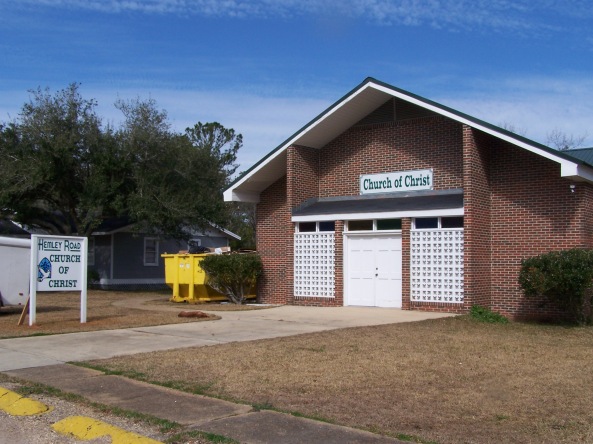
blb_bldgThis past Monday I received an excited phone call from our partner in the gospel, Daphne German from the Hemley Road church of Christ. On last Sunday they had their first baptism of the year, and in the church’s brand new baptistery. A 51 year old widow was baptized by brother Billy Spalding. What joy the church shared as they witnessed this event.

The baptistery is not trimmed out yet, but it held warm water (a very positive thing since the church has no heat, or A/C for that matter) and this was the first of what will be many, many baptisms at HRC. The baptistery was a love gift from a sister church at La Place, Louisiana. When they learned that their brothers and sisters in Bayou La Batre were in need they responded. Many thanks to the church in La Place for their expression of charity.

Since its inception after Hurricane Katrina, the Hemley Rd church has had no less than 10 baptisms each year. For a congregation with only a few mature believers they are doing a wonderful job of getting out the gospel and loving the people of the Bayou. They have an on going food pantry, still repair citizens houses and give tons of clothing, food, and furniture each year, facilitate an on going Grief Share ministry, and put the gospel in shoe leather in their community.

Never have I met any Christians who are more determined, live more sacrificially, and are more filled with faith than Christ’s ambassadors at HRC. Against overwhelming odds and in the face of severe opposition they have continued straight ahead. They live by faith and are bringing hope and deliverance to the folks of the bayou through their Christ centered ministry and message.

I thank God for our friends at Hemley Rd church in Bayou La Batre, Alabama. They have many needs, not the least of which is an air conditioning unit for the church building, the fellowship building, and the house on the property. Last summer when the temperatures were in the high 90’s they fed children, had classes, and worshiped with only a couple of fans to move the air. They have ministered all winter without heat, but have continued because of the warmth of their hearts.

Do you know an HVAC contractor who loves God? Tell him about the needs at HRC. Why not stop fretting about the decline of the DOW index and invest that money in something with an eternal benifit? At a minimum, please put these dear people on your prayer list and lift them to our Father.

I couldn’t be prouder of my forever family at the Hemley Rd church of Christ in Bayou La Batre. Many thanks to them for being examples of what a church should look like. May God continue to bless them and you.

For the very good news about Jesus,
Royce Ogle